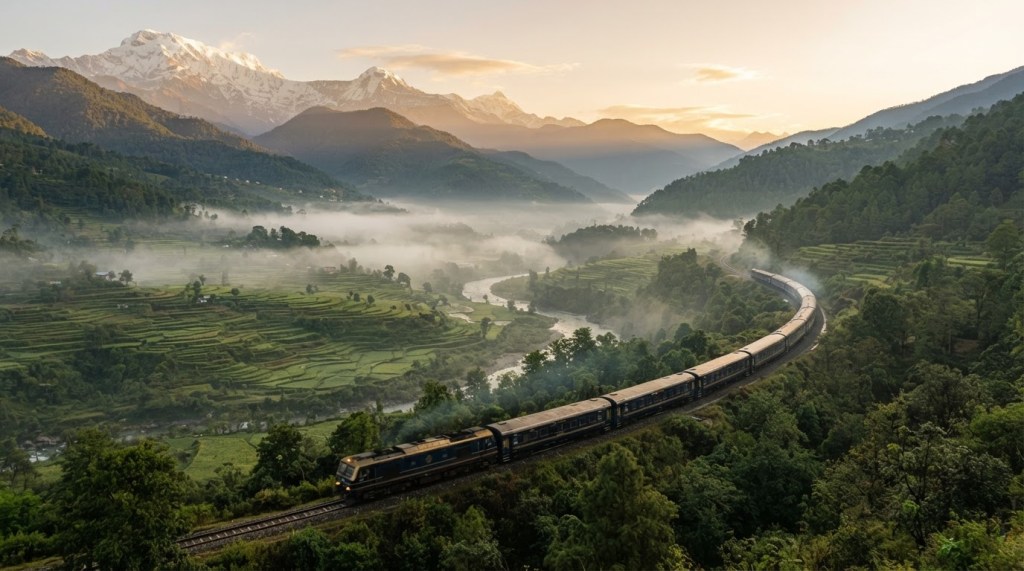
A journey does not always become memorable because of the place where it ends. Sometimes the most vivid part is the stretch of time spent moving towards it, when the scenery changes gradually and the mind has room to wander. Train travel creates a particular kind of space for that experience. Unlike a flight, which can make distance feel almost instant, or a car journey that demands attention from the driver, a passenger train allows the landscape to pass at a steady, visible pace. The traveller can watch a valley open, a river turn beside the tracks and a distant settlement appear before the train carries the view away.
The morning train has its own atmosphere. Platforms begin to stir while the sky is still pale, vendors arrange their small counters and passengers settle into seats with the quiet concentration of people beginning a long day. Some carry elaborate luggage, while others have only a small bag and a familiar routine. A station is not simply a point on a route; it is a meeting place for journeys that are beginning, continuing and ending at different speeds. Observing that movement gives the traveller an early sense of the region beyond the destination printed on the ticket.
Once the train leaves the station, the window becomes a moving frame through which the country reveals itself. Dense buildings may give way to open fields, then to low hills, wooded slopes or broad river plains. In mountainous regions, the route can curve around ridges and cross bridges that make the scale of the landscape suddenly clear. The same view rarely remains unchanged for long. Light moves across the terrain, clouds gather above distant peaks and small details appear only for a few seconds. The traveller learns to look without expecting every scene to wait.
That changing view encourages a slower form of attention. A person who is used to filling every spare minute with a screen may initially find the unstructured time unfamiliar. After a while, the rhythm of the wheels, the movement of trees and the changing colours outside can become enough. A book may be read in short stretches, a conversation may begin and end naturally, or a notebook may collect observations that would have been forgotten in a faster journey. The value is not in doing nothing for the sake of it. It is in allowing the journey to have its own pace instead of treating every minute as an empty space that must be filled.
Small railway stations often offer some of the most revealing glimpses of everyday life. A platform may hold a tea counter, a group of schoolchildren, a porter arranging luggage or a family waiting for someone to arrive. These scenes are not arranged for visitors, and their ordinary quality is precisely what makes them interesting. A traveller can notice how a place wakes up, what people carry with them and how local routines shape the station. The most respectful way to observe is quietly, without turning private moments into photographs or assuming that every person wants to become part of a travel story.
Conversations on trains can be just as varied as the scenery. Fellow passengers may share practical advice about a connection, recommend a regional dish or explain why a particular stretch of track is known for its views. Some journeys are filled with conversation, while others are spent in comfortable silence. Neither experience is better than the other. A considerate traveller recognises the signals that another person is open to talking and respects those who prefer privacy. The shared setting can create a temporary sense of companionship without requiring strangers to become close friends.
Good rail journeys also depend on sensible preparation. Checking the correct station, departure time, platform information and transfer arrangements reduces avoidable stress. A small supply of water, food, medication and essential items can make a long journey more comfortable, especially when services are limited. Travellers should keep valuables secure, follow railway rules and remain attentive when boarding or changing trains. In unfamiliar regions, local announcements and official travel information are more reliable than assumptions based on an old timetable. Flexibility is useful, but preparation gives that flexibility a safer foundation.
Train travel can also change the way a traveller thinks about distance and environmental responsibility. Rail can be an efficient option on many routes, particularly where a good network connects towns and cities, although the overall impact depends on the service, energy source and alternatives available. The wider benefit is that a journey can be planned around shared transport rather than automatically relying on a private vehicle. Choosing a train does not make every trip sustainable by itself, but it can be one practical part of travelling with greater awareness of resources, local infrastructure and the effects of movement.
Photography often becomes tempting when the landscape is especially beautiful, yet the window offers more than a collection of images. Reflections, glare and movement can make photographs imperfect, and a person who spends the entire journey trying to capture every view may miss the experience itself. A few photographs can preserve a memory, but looking directly at the changing scenery allows details to register more deeply. The sound of the carriage crossing a bridge, the sudden appearance of sunlight after a tunnel or the quiet excitement of approaching a new station may remain more vivid than any picture.
Not every rail journey follows the planned rhythm. A delay, a missed connection or a change in weather can interrupt the schedule. Such moments can be frustrating, especially when other commitments depend on arrival time, but they also test the traveller’s ability to respond calmly. Reliable information, a little extra time and a willingness to revise plans can prevent a small disruption from defining the entire trip. The experience is not an argument for ignoring inconvenience. It is a reminder that movement through the world involves variables that cannot always be controlled.
When the train finally reaches its destination, the traveller may remember the place itself, but the journey will have added another layer to that memory. The changing landscapes, station conversations, quiet pauses and small surprises have made the distance feel real. A morning train offers a lesson that applies beyond travel: not every meaningful experience needs to be hurried towards its conclusion. Sometimes a slower route gives people the chance to notice more, understand a place more generously and arrive with a story that began long before the final station.

