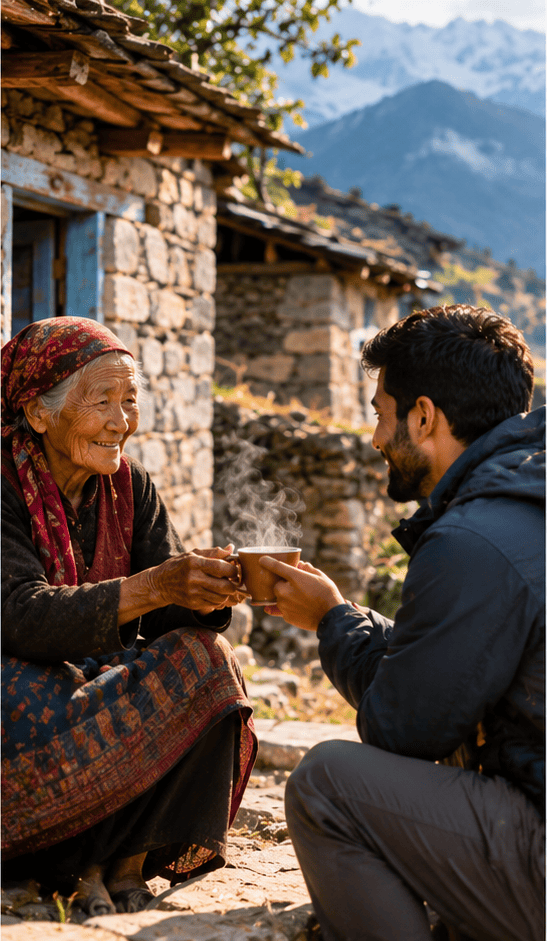
Travel memories are often expected to come from spectacular places: a mountain pass, a famous monument, a difficult climb or a view that seems too beautiful to be real. Yet many journeys are remembered through much smaller scenes. A roadside stall, a warm cup of tea and a conversation that lasts only a few minutes can remain vivid long after the photographs have been organised. These moments do not compete with the destination. They give it a human scale, reminding the traveller that a place is not only a landscape to admire but also a setting where ordinary lives continue.
A roadside tea stop has a particular rhythm. The vehicle slows, the engine falls quiet and the traveller steps away from the movement of the road. There may be a small counter, a few benches and a kettle working steadily over a flame. The view could be a valley, a busy junction or a row of houses, but the pause changes how it is experienced. Instead of looking through a window while passing by, the traveller becomes part of the scene for a little while. The smell of tea, the sound of cups and the brief rest from the journey create a moment that feels separate from the schedule.
Such pauses also reveal how much a journey depends on people whose work is rarely included in travel stories. The person preparing tea may have opened the stall before sunrise, remembered the preferences of regular customers and spent years watching travellers come and go. A driver may know which stop offers a safe place to rest or where the road becomes difficult after rain. A shopkeeper may be able to explain the local weather better than an online forecast. These everyday forms of knowledge make travel possible, even when they remain invisible to visitors.
Conversation often begins with something ordinary. Someone asks where the traveller has come from, whether the road ahead is clear or how long the journey will take. The answer may lead to a question about the village, the season or a nearby place worth visiting. Not every exchange becomes a deep discussion, and it does not need to. A few genuine words can be enough to make a stranger feel less like a passing face. When language is limited, a smile, a gesture or a shared laugh can carry the interaction forward without forcing it to become more than it is.
The value of these conversations lies partly in their lack of expectation. The traveller is not attending a formal tour or trying to collect a perfect story. The other person is not required to perform local culture for an audience. They are simply sharing a moment in the middle of an ordinary day. This creates room for a more respectful kind of curiosity. A visitor can ask about a local dish, a change in the weather or the meaning of a place name, while accepting that the person may be busy or may not wish to talk. A good conversation leaves both people comfortable.
These small encounters can also change the way a traveller sees a destination. A mountain road may initially seem like a route between two viewpoints. After a pause at a tea stall, it becomes a place where people commute, deliver supplies, meet friends and manage the practical demands of daily life. The landscape remains beautiful, but it is no longer distant or abstract. It has routines and relationships. The traveller begins to understand that the place exists independently of the visit and that its significance cannot be reduced to the number of photographs taken there.
A cup of tea can feel familiar even when everything around it is new. The warmth in the hands, the pause between sips and the simple act of sitting down are recognisable across many cultures. The preparation may differ, the spices may be unfamiliar and the cup may be made of glass, steel or clay, but the gesture of offering a drink has a quiet universality. It can create a temporary sense of belonging without pretending that the traveller has become part of the community. For a brief moment, the distance between visitor and host becomes less important than the shared experience.
Remembering such moments also requires a little attention. A traveller who spends the entire break checking messages or rushing to the next stop may miss the very experience that made the pause worthwhile. Putting the phone away, noticing the surroundings and listening to the person speaking can make a short stop feel complete. Photographs may be taken when appropriate, but asking permission matters, especially when people are identifiable. The moment should not be turned into content at the expense of the person who helped make it meaningful.
The best travel plans leave room for these unscheduled pauses. A realistic itinerary can include time for meals, rest and unexpected delays instead of treating every minute as a chance to visit another attraction. This does not mean travelling without preparation. It means recognising that a journey is made of transitions as well as destinations. A ten-minute stop can restore energy, offer useful local information and create a memory that no checklist could have predicted. Flexibility often makes a trip feel richer rather than less organised.
Long after the road has been left behind, the traveller may struggle to remember the exact time of the stop or the name of the small settlement where it happened. What remains is the warmth of the cup, the view beyond the counter and the feeling of being welcomed into an ordinary moment. A good journey does not consist only of places reached; it also includes the pauses that allow those places to become real. Sometimes a cup of tea and a simple conversation are enough to make a distant road feel unexpectedly close to home.

