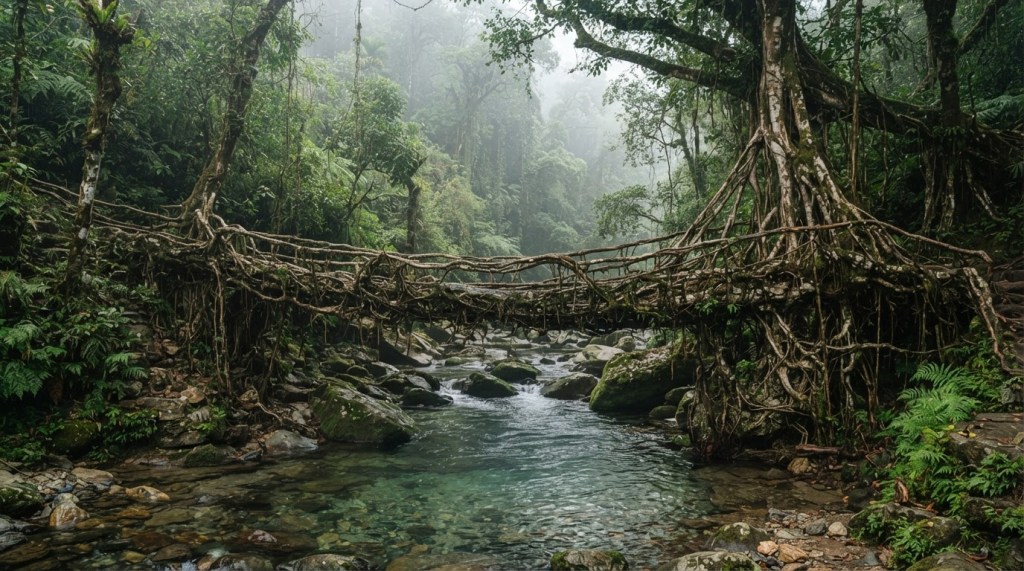
In the green hills of Meghalaya, a bridge can begin as a tree and take shape over the course of a generation. Streams cut through deep valleys, rain gathers quickly beneath the forest canopy, and paths between villages have long needed to withstand conditions that can wear away ordinary structures. In this landscape, Khasi and Jaintia communities developed a remarkable answer: instead of building a bridge from material that eventually decays, they guide living roots until they form a crossing. The result is neither simply a natural feature nor a conventional construction. It is a piece of living architecture, shaped by human knowledge and continued growth.
The bridges are commonly formed from the aerial roots of the Indian rubber fig, Ficus elastica. Young roots are encouraged to travel in a chosen direction, often through hollowed trunks of areca nut palms or along bamboo guides stretched across a stream or ravine. The guides give the roots a route while they lengthen, branch and gradually reach the opposite side. Over many years, people guide additional roots into the structure, weave them together and strengthen the walking surface. Stones may be fitted into gaps, while steps and handrails are added where the terrain requires them. What looks effortless in a photograph is the result of patient attention.
Time is one of the most striking materials in this form of engineering. A newly guided root does not become a dependable bridge in a season. The Meghalaya Biodiversity Board describes development periods that can extend to roughly fifteen to twenty-five years, depending on the structure and its conditions. Even after a crossing becomes usable, it is not finished in the way a concrete project might be declared complete. Roots continue to grow, thicken and respond to the environment. People continue to inspect, guide and maintain them. The bridge is therefore an ongoing relationship between a tree, a community and the landscape rather than an object delivered on a single day.
The best-known example is the double-decker living root bridge near Nongriat, where two levels of interwoven roots cross a stream in a deep, forested valley. Its unusual form tells a practical story as well as an architectural one. A lower crossing can become difficult when water rises, and a second level offers another way across. Elsewhere in the Khasi and Jaintia Hills, smaller bridges serve local routes and connect settlements with fields, paths and neighbouring communities. Each structure has its own proportions and history because the builders respond to the particular river, slope, tree and needs of the people who use it.
Reaching a bridge can be an experience in its own right. The approach often involves steep paths, stone steps, humid forest air and the sound of water long before the crossing comes into view. The walk encourages a slower pace. A traveller begins to notice how roots grip rock, how streams change colour beneath shifting light and how the forest floor holds moisture even when the path rises above the water. The bridge appears gradually, first as a dark shape between leaves and then as a network of roots strong enough to carry footsteps. Its scale becomes clearer when the surrounding trees and river are seen together.
Yet the most meaningful part of the visit is not the photograph taken from the middle of the bridge. These structures are part of living village landscapes, and their value comes from the knowledge and labour that keep them useful. Community members have to understand which roots need guidance, where a surface needs repair and how changing weather affects a crossing. The UNESCO World Heritage Centre’s tentative-list description recognises the bridges as cultural landscapes that support rural connectivity and reflect knowledge passed between generations. That recognition is important, but the everyday work remains local. The bridge belongs first to the people whose routes, responsibilities and memories are connected to it.
Tourism can help sustain local livelihoods when visitors choose guides, homestays and services run by the communities that care for the bridges. It can also create pressure when too many people crowd onto a structure or treat the surrounding forest as a disposable backdrop. A considerate visitor follows the route set by local guides, respects any limits on numbers, avoids pulling or climbing on roots and carries every piece of waste back out. The walking surface should be treated as a shared passage, not as a stage for risky poses. Asking before photographing residents and learning the local name or story of a bridge are small ways to show that the place is more than a scenic attraction.
The bridges also invite a broader conversation about what durable infrastructure can mean. They are not a universal replacement for modern roads or bridges, and they require suitable trees, climate, terrain and generations of care. Their lesson is more specific and perhaps more valuable: engineering can work with biological processes instead of always trying to control them. The roots are not passive decoration. They are the structure itself, living and changing as the community maintains it. Such a system asks for patience, cooperation and an understanding of the limits of the environment. It demonstrates that local knowledge can produce solutions that are difficult to design from a distant blueprint.
A journey to Meghalaya’s living root bridges is therefore not only a search for an unusual crossing. It is an encounter with a way of thinking in which construction is measured in years, maintenance is shared and the natural world is treated as a partner. The traveller may leave with a photograph of roots stretching over a stream, but the more lasting memory is the thought of people guiding a bridge that will continue to grow after they are gone. In a world accustomed to instant results, these forest footpaths offer a quieter measure of achievement: something made slowly, cared for collectively and kept alive for those who will walk there next.

