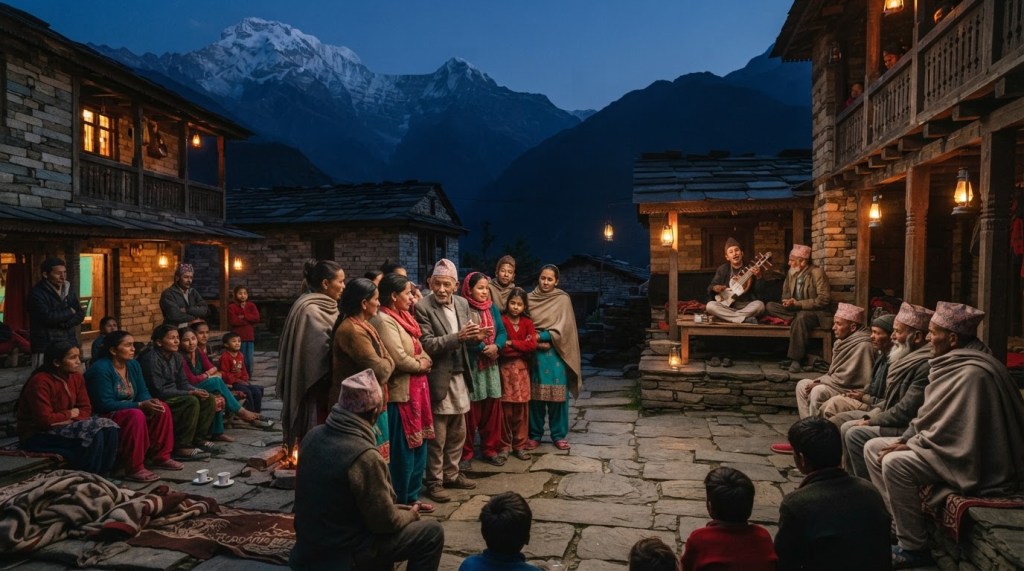
A village gathering can appear effortless to someone who arrives just as the evening begins. A courtyard fills with neighbours, familiar faces greet one another, children move between groups and older residents find their usual places. There may be music, a seasonal observance, a local announcement or simply an occasion for people to spend time together. The visitor sees a lively scene, but much of its meaning has already been created through hours of preparation. Tables have been arranged, spaces cleaned, food or refreshments organised and responsibilities quietly shared. Looking beyond the visible celebration reveals how community life is maintained through ordinary cooperation.
Every gathering has its own character, shaped by local history, climate, belief, family relationships and the reason people have come together. A harvest celebration may carry different expectations from a religious observance, a wedding or a neighbourhood meeting. Even two villages in the same region may organise similar occasions in different ways. A traveller who assumes that one event represents an entire culture risks overlooking the particular people and circumstances that give it meaning. Curiosity is more useful when it begins with observation and a willingness to learn rather than with a ready-made explanation.
The preparations often reveal as much about a community as the event itself. Some residents may arrange seating, others may prepare a shared space, and younger members may help older relatives with tasks that require time or physical effort. People who are not formally in charge may still know exactly what needs doing. Responsibilities can be distributed through long-standing relationships rather than written instructions. A visitor who notices this shared effort begins to understand that community is not simply a group of people gathered in one place. It is a network of practical commitments that becomes visible when something needs to be done together.
Generations may participate in different ways. Children learn where to stand, when to greet someone and how to behave by watching older family members. Adults manage arrangements while elders may preserve stories, customs or decisions that connect the occasion to earlier years. These roles are not always fixed, and they can change as families and communities change. The gathering creates an opportunity for knowledge to move between generations without a formal lesson. A young person may learn a song, a greeting or a responsibility simply by being included. The visitor can see how traditions remain alive through participation rather than through display alone.
Music and performance can add energy to a gathering, but they are only one part of the occasion. The pauses between performances, the conversations across age groups and the small gestures of recognition may carry equal importance. A familiar tune can remind residents of earlier celebrations, while a shared joke can reconnect people who have not met for months. For a traveller, these details offer a more grounded understanding than a short description of the event’s most visible attraction. The gathering is not staged for an audience. It is a social space that belongs first to the people who have created it.
Visitors should approach an invitation with appreciation and good judgement. An open public event may welcome newcomers, while a family or religious occasion may have boundaries that are not immediately obvious. A traveller can ask a host or local organiser whether participation is appropriate, where to sit and whether there are customs to observe. Clothing, footwear, photography and food arrangements may all carry expectations. If the answer is uncertain, watching quietly from an appropriate place is better than assuming that enthusiasm grants permission. Respectful participation begins by recognising that hospitality does not remove a community’s right to privacy.
Photography deserves particular care because a lively gathering can make it tempting to record everything. People may be comfortable being photographed in one setting and uncomfortable in another. Children, elders and private family moments deserve special consideration. Asking before taking close photographs, accepting a refusal without argument and avoiding images that make people look like curiosities are basic signs of respect. A visitor should also consider whether sharing a photograph publicly could reveal information that someone would prefer to keep within the community. Sometimes the most meaningful memory is one that remains personal rather than becoming a post online.
Taking part does not always require a large contribution. A visitor may be invited to help carry chairs, join a simple activity or learn a greeting. Such participation should remain within the limits set by the hosts. It is not appropriate to insert oneself into organising decisions or treat an unfamiliar custom as an activity to be tested for entertainment. Listening to instructions and following the pace of the event allows the traveller to contribute without taking attention away from its purpose. If no role is offered, showing appreciation and allowing the gathering to continue naturally is also a form of participation.
The experience can challenge the idea that community is built only through dramatic acts of generosity. Much of it depends on repeated, practical gestures: remembering who needs assistance, checking whether an older neighbour has arrived, making room for a late guest or helping to clear the space afterwards. These actions rarely attract attention, yet they make gatherings possible. A traveller may recognise similar patterns in their own neighbourhood after returning home. The setting may be different, but the underlying work of maintaining relationships is familiar. Seeing it clearly can make an ordinary local event feel unexpectedly significant.
When the gathering ends, the courtyard gradually returns to its usual appearance. Chairs are stacked, lights are switched off and people begin the walk home, sometimes continuing conversations along the lane. The visitor may remember the music or the colours of the evening, but the deeper impression often comes from seeing how many people contributed to a shared occasion. A village gathering offers more than a glimpse of local culture. It shows community as something actively made through preparation, memory, cooperation and respect. For a traveller, that understanding can be more lasting than any single performance or photograph.

