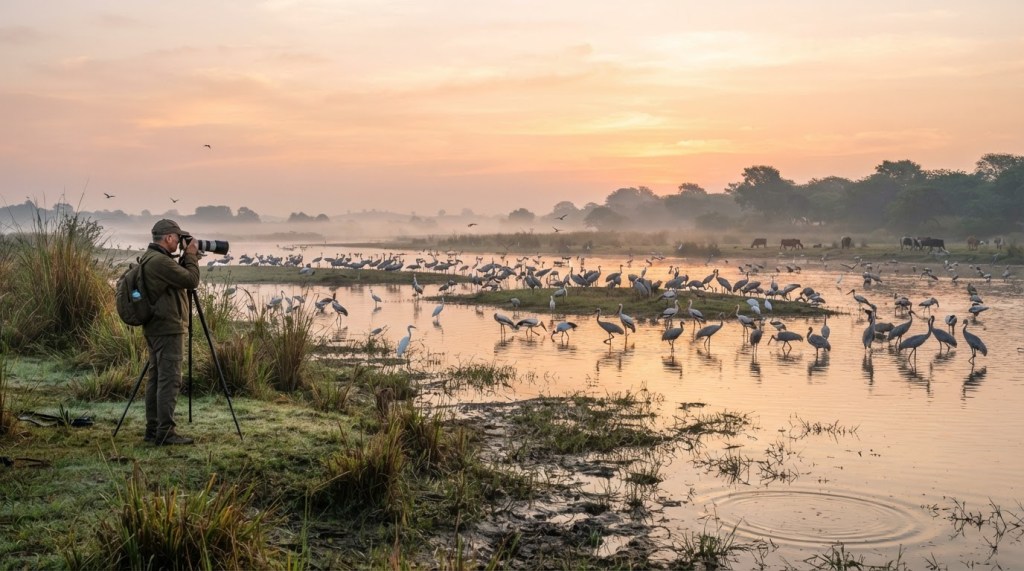
Some landscapes announce themselves with mountains, waterfalls or dramatic coastlines, while wetlands often reveal their character more gradually. At first glance, a marsh may appear to be a broad stretch of shallow water, reeds and mud. A traveller who pauses, however, begins to notice movement everywhere: a bird lifting from the grass, ripples spreading across a pool, or a line of waders searching the shallows for food. The place becomes a living pattern rather than an empty view. Wetland birdwatching offers a distinctive kind of exploration because it rewards patience, attention and a willingness to let the landscape set the pace.
The first lesson of observing birds is that a wetland is not simply a scenic stop. It is a habitat shaped by water levels, vegetation, soil, weather and seasonal change. Different species use different parts of the same environment. Some feed in open shallows, others remain close to reeds, and some arrive only during particular periods of the year. A visitor does not need to know every species to appreciate this complexity. Even a basic understanding of feeding areas, nesting spaces and seasonal movement can make the landscape easier to read and help explain why protecting the whole habitat matters.
Early morning often offers favourable conditions for observation. The air may be cooler, the light softer and the water relatively calm before the day becomes busy. Birds can be active as they search for food, while reflections and mist give the scene a changing atmosphere. The experience does not depend on sunrise alone, however. Different wetlands have different rhythms, and local guides or conservation groups can explain when particular habitats are most active. A thoughtful traveller checks access conditions and seasonal guidance rather than assuming that every wetland should be visited at the same hour or in the same way.
Equipment can help, but it does not need to become the centre of the outing. A modest pair of binoculars allows a visitor to observe birds without approaching them, while a notebook can preserve details that a photograph may miss. A camera with a long lens can be useful for those who already understand how to use it responsibly. Beginners can learn a great deal by watching movement, posture and feeding behaviour before trying to identify every bird. The most rewarding observation often begins with a simple question about what an animal is doing and why that part of the habitat might suit it.
Patience is particularly important because birds do not arrange their behaviour for visitors. A flock may remain still for several minutes and then move together in an instant. A solitary bird may disappear behind reeds just as someone raises a camera. Instead of treating these moments as disappointments, an observer can learn to appreciate the uncertainty. Waiting quietly makes it possible to notice smaller changes: the way a bird tests the mud with its bill, adjusts its feathers or reacts to a distant sound. The landscape becomes more interesting when attention is directed towards behaviour rather than a perfect photograph.
Respectful observation protects both wildlife and the quality of the experience. Visitors should remain on permitted paths, keep a generous distance from nesting areas and avoid calling, feeding or chasing birds to bring them closer. Drones, loud playback recordings and sudden movement can disturb animals even when the intention is only to obtain a better view. Flash photography may also be inappropriate in sensitive settings. Local rules should be followed, and a guide’s advice should take priority over a visitor’s desire for a particular sighting. The best encounter is one in which the bird continues its normal behaviour without having to respond to human interference.
Wetlands also connect visitors to the wider story of water and human settlement. Many communities depend on these areas for fishing, farming, grazing, flood management or other local needs. Their knowledge of seasonal water levels and wildlife can be valuable, but it should not be treated as information that visitors are automatically entitled to collect. A respectful traveller listens, asks permission before taking identifiable photographs and recognises that local people may have different priorities from conservation organisations or tourists. Understanding a wetland means recognising both its ecological importance and the lives that have developed around it.
Keeping a simple field record can deepen the visit. Notes about the time, weather, water level, bird behaviour and visible species create a personal record of the landscape. Repeated visits may reveal changes that a single outing cannot show, such as the arrival of seasonal visitors or shifts in the amount of exposed mud. A visitor does not need to present these notes as scientific research. They are a way of learning to pay attention consistently. When observations are shared with a credible local conservation group or citizen-science project, they may also contribute useful information, provided the recording method follows that project’s guidance.
The condition of a wetland can change quickly when water is diverted, waste accumulates or surrounding land is developed without care. Visitors may notice signs of pressure, but they should avoid making sweeping conclusions from one short visit. Reliable local conservation organisations can explain the challenges affecting a particular area and identify practical ways to support protection. Responsible tourism may include choosing guides who follow wildlife guidelines, respecting entry restrictions and supporting community-led conservation work. Even small decisions matter when many visitors make them. A quiet landscape remains available for future generations only when people treat it as more than a backdrop.
By the end of a morning in the wetlands, a traveller may have identified only a few birds and taken very few photographs. The visit can still feel rich because the experience has changed the way the landscape is seen. Water, reeds and open sky no longer appear separate from the lives moving through them. Each sound or ripple suggests a relationship within a larger system. Birdwatching is rewarding not because it guarantees rare sightings, but because it trains the observer to notice what is already present. The wetlands offer a gentle reminder that exploration can begin with stillness, and that some of the most revealing journeys happen when a person learns to look carefully rather than move quickly.

