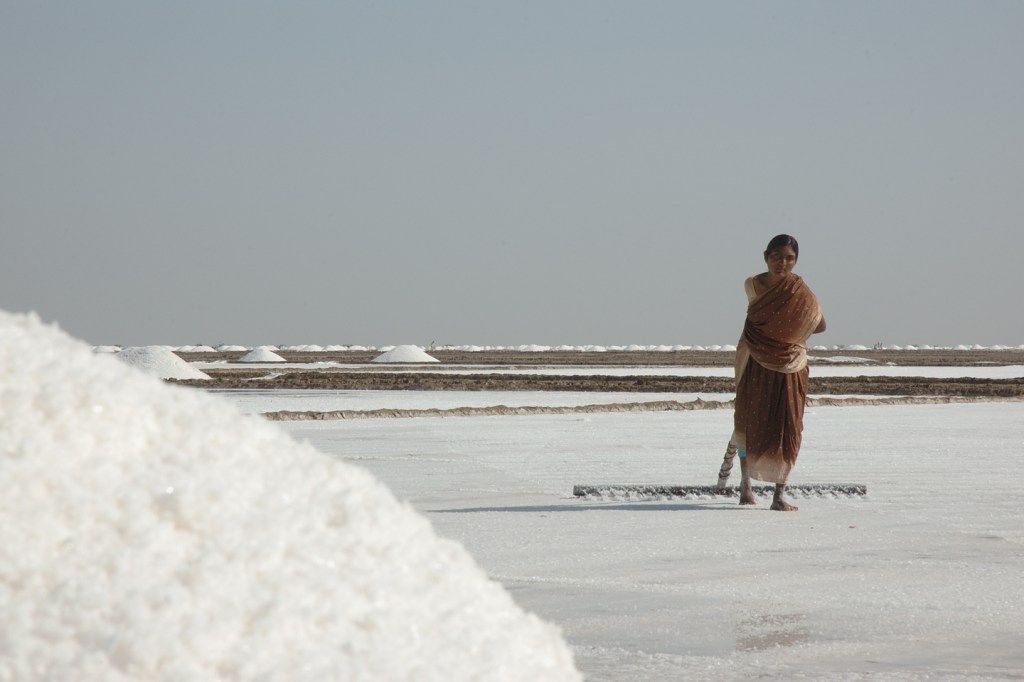
At first glance, the Rann of Kutch can appear almost unreal. A wide white horizon stretches beneath an enormous sky, and the ground seems to merge with the light until distance becomes difficult to judge. Visitors often arrive expecting a striking landscape and leave with photographs of an endless pale surface. Yet the salt desert is not simply a natural spectacle. In parts of Kutch, the seasonal landscape is also a workplace, shaped by generations of knowledge about water, weather and the slow process through which salt is brought to the surface. The most meaningful journey begins when a visitor looks beyond the view and notices the people whose labour gives the place another dimension.
The Rann changes with the seasons. During the monsoon, large areas are inundated, and the landscape can become difficult or impossible to cross. As the water recedes and the dry months arrive, salt production becomes possible in selected areas. Workers prepare shallow pans, manage brine and wait for evaporation to leave crystals behind. The process depends on timing, temperature, wind and careful observation. It is a practical relationship with the environment rather than a simple industrial routine. The same sun that creates a beautiful glow for a visitor can also make a long working day physically demanding for someone who must remain on the exposed ground.
Salt work requires patience and a detailed understanding of local conditions. Brine is directed into prepared beds, allowed to evaporate and then gathered as the concentration increases. The surface may look still from a distance, but the work involves repeated movement, checking, raking and carrying. A worker has to judge when the crystals are ready and how to handle them without wasting effort. Small decisions are shaped by experience built over many seasons. The process offers a reminder that knowledge is not found only in books or formal institutions. It is also held in the routines of people who understand a landscape through daily contact with it.
The people who work in the salt pans are often described as part of the story of the Rann, but their lives should never be reduced to a picturesque detail. Seasonal work can involve long hours, intense glare, heat, isolation and uncertainty about earnings. Families may organise their lives around the production season, moving between settlements and work areas as conditions change. The white landscape can look peaceful in a photograph while concealing the effort required to earn a living there. A thoughtful traveller recognises this contrast and avoids treating workers as props for a travel image. Their dignity and privacy matter more than a memorable frame.
A visit to the Rann is best planned with local guidance. Access conditions, routes and permitted areas can change with the season, weather and conservation requirements. Some locations may be restricted, while others may require a local guide or an organised visit. Travellers should confirm current arrangements before setting out rather than relying on an old itinerary. The open terrain can make distances deceptive, and the bright surface may cause discomfort even when the air feels cool. Suitable footwear, sun protection, drinking water and a realistic schedule help make the experience safer. A guide can also explain which areas are working salt pans and which places should remain undisturbed.
The most respectful way to photograph the salt landscape is to begin by observing. Wide views of the pans, reflections and distant horizons can communicate the scale of the region without placing a camera directly in someone’s face. When a worker becomes the subject, permission should be requested clearly and without pressure. A person who declines should be left in peace. Visitors should not ask workers to repeat a task, pose beside equipment or interrupt their work for a photograph. The scene is not a performance arranged for tourists. It is part of someone’s livelihood, and the visitor is only a temporary guest in that space.
The wider ecology of Kutch deserves equal attention. The region includes salt marshes, grasslands, wetlands and habitats that support wildlife adapted to difficult conditions. Seasonal water, open flats and nearby grassland create a landscape that changes in ways a casual visitor may not immediately understand. Driving away from marked routes can damage fragile ground, disturb wildlife and leave tracks that remain visible long after a vehicle has passed. Litter is especially unwelcome in a place where wind can carry light waste over a large area. Responsible travel means following local instructions, keeping vehicles in permitted areas and taking every piece of waste back out.
The cultural life of Kutch adds further depth to a visit. Villages across the region are known for distinct craft traditions, textiles, embroidery, music and forms of hospitality that vary from community to community. These traditions should not be treated as a single display of local colour. A visitor can learn more by spending time with a knowledgeable guide, visiting a community enterprise with permission or purchasing directly from an artisan when the arrangement is fair and transparent. Asking about the time and skill behind a piece of work often creates a better exchange than bargaining only for the lowest price. The experience becomes richer when curiosity is paired with respect.
The Rann is often associated with festivals and carefully arranged excursions, but it also rewards travellers who allow enough time to understand the setting. A sunrise visit may reveal cool air and long shadows; later, the same surface can become intensely bright. The colours shift with the weather, and the horizon changes as clouds move across it. A traveller who stays for more than a quick photograph may begin to notice the relationship between the land, the work and the changing season. There is no need to rush from one viewpoint to another. The place has its own pace, and a good visit leaves room to experience it.
The salt pans of Kutch reveal a powerful contrast between beauty and effort. Their white surfaces can make the landscape feel empty, yet the region is full of human knowledge, seasonal decisions and quiet resilience. A journey there becomes more meaningful when it recognises the workers, respects the ecology and listens to local explanations rather than relying only on the view. The Rann is not a backdrop waiting to be consumed; it is a living landscape with its own limits and rhythms. The traveller who leaves with that understanding carries home more than a photograph. They carry a clearer sense of how people and places shape one another.

