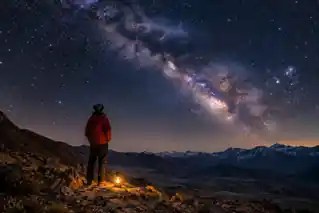
Most journeys are planned around daylight. Travellers choose a viewpoint for sunrise, arrange a walk for the afternoon and return before the evening becomes difficult to navigate. Yet some landscapes reveal another character after dark. When the last light slips behind a ridge and nearby settlements grow quiet, the sky begins to show details that remain hidden above illuminated streets. A clear night can turn an ordinary stop into an unforgettable experience, not because anything dramatic happens, but because the scale of the universe becomes suddenly visible. Stargazing invites a traveller to pause and let the destination be experienced in a different way.
Dark skies are becoming harder to find near large towns and cities. Streetlights, advertising boards, vehicle headlights and brightly lit buildings scatter light into the atmosphere, reducing the contrast between stars and the background sky. In remote deserts, high mountain valleys and lightly populated rural regions, the difference can be striking. The Milky Way may appear as a pale band, familiar constellations become easier to trace, and the sky seems deeper than it does from home. The value of such places is not simply that they look beautiful at night. They also offer a reminder that darkness is a natural condition worth protecting.
India has landscapes where night-sky experiences can become part of a wider journey. The high-altitude regions of Ladakh and Spiti, quiet stretches of the Thar Desert and some rural areas far from major urban centres can offer memorable views when weather and local conditions cooperate. A destination should never be chosen on photographs alone, however. Cloud cover, haze, moonlight, season, road access and local rules all influence what can actually be seen. A location described as remote may still have nearby lighting or difficult access. Recent local advice is more useful than an old image promising a perfect sky.
Preparation matters because a night outdoors has different demands from a daytime visit. Travellers should check the forecast, understand the route back to their accommodation and avoid unfamiliar drives after dark. In high-altitude areas, acclimatisation and awareness of cold, wind and altitude-related symptoms are essential. Warm layers, suitable footwear, drinking water and a reliable light should be carried even when the plan is only to stand outside for a short time. A stargazing outing should not encourage anyone to ignore local safety guidance or enter restricted land. The night sky is worth enjoying, but not at the cost of sound judgement.
A little knowledge can make the experience richer without turning it into a technical exercise. A simple star chart or an offline astronomy application can help identify a few bright constellations and planets. Binoculars are often enough to reveal details around the Moon or clusters of stars, while a telescope is not necessary for a first experience. A red-light torch helps preserve night vision better than a bright white beam, and a phone screen should be kept dim. The most useful equipment is often patience. The eyes need time to adjust, and the sky rewards those who resist the urge to keep checking a screen.
Local knowledge adds a dimension that equipment cannot provide. Guides and residents may know which open areas are safe, where weather changes quickly and which places should remain undisturbed. In many communities, stars and seasonal patterns have long been part of navigation, farming, storytelling and cultural memory. Listening to these accounts can make the sky feel connected to the landscape rather than like a distant scientific display. Such conversations should be approached respectfully. A traveller is a guest, not an owner of local knowledge, and should never pressure people to perform traditions or share stories they prefer to keep private.
Photography can preserve a night-sky memory, but it can also become a distraction. Long exposures require a stable tripod, a suitable camera setting and a little experimentation, yet a perfect photograph is not guaranteed. A phone may capture a few bright stars, while a dedicated camera can reveal more detail under suitable conditions. Bright screens and repeated flashes can disturb other visitors and reduce everyone’s ability to see the sky. It is worth taking a few photographs and then putting the device away. A person who spends the entire night adjusting equipment may return with images but little memory of the silence around them.
Responsible stargazing also means recognising that wilderness does not become empty when people stop seeing it. Nocturnal animals depend on darkness, and artificial light can alter their behaviour. Visitors should avoid shining powerful torches into vegetation, disturbing wildlife or leaving food and packaging behind. Campfires may be prohibited or unsafe in dry and windy areas, so local fire rules must be followed. Vehicles should be parked only in permitted places, and music should be kept low or switched off. A quiet night is part of the experience for everyone nearby, including the people and animals who live there throughout the year.
The moon is another important part of the night sky. A bright full Moon can wash out faint stars, but it can illuminate mountains, dunes and water in ways that create a different kind of beauty. A darker moon phase is generally better for seeing the Milky Way, while a moonlit night may suit travellers who prefer a visible landscape and a gentler introduction to astronomy. Neither experience is automatically superior. The best plan depends on what the traveller hopes to observe and how much time is available. Flexibility allows the night to be appreciated even when the sky does not match a forecast or photograph.
By morning, the same landscape may look familiar again, yet the night can change the way it is remembered. The traveller may recall the cold air, the outline of a distant ridge, a guide pointing out a constellation or the surprising brightness of a planet. Stargazing does not require an expensive expedition or a complicated scientific background. It asks for a safe location, respect for local conditions and enough time to look upward without hurry. In a world where so much attention is directed toward glowing screens, a genuinely dark sky offers a rare kind of perspective. It makes the journey feel larger, quieter and more connected to the natural world.

