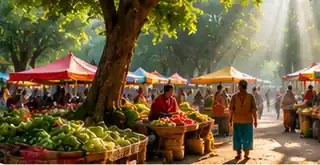
A destination can be recognised by its monuments, mountain views or famous streets, but its everyday character is often easier to understand in a local market. Markets gather the practical details of a place into one lively setting. Produce arrives from nearby farms, familiar ingredients sit beside unfamiliar ones, shopkeepers prepare for regular customers and conversations move between prices, weather and family news. The market is not arranged for visitors. It exists because people need to buy, sell, exchange information and maintain routines. For a traveller willing to slow down, that ordinary purpose makes it one of the most revealing places to visit.
The first impression is usually a mixture of movement and sound. Vendors call out the day’s prices, customers compare vegetables, delivery workers move baskets and a shopkeeper weighs a purchase with practised speed. The scene may appear chaotic to someone arriving from a quieter street, but it often follows a rhythm understood by the people who use it every day. Certain stalls attract regular customers, particular goods appear only in specific seasons and familiar faces greet one another without ceremony. Observing these patterns helps a visitor see that a market is not simply a collection of colourful stalls. It is a working network of relationships.
Food provides one of the clearest ways to understand regional identity. A market may display grains, fruits, vegetables, spices, fish or preserved ingredients shaped by local climate and cooking habits. Some items may be common across the country but prepared differently from one region to another. Others may be seasonal or associated with a particular festival. A traveller who asks a respectful question about an unfamiliar ingredient may learn how it is cooked, when it is available or why it matters to local households. Such details create a more grounded understanding of cuisine than a restaurant menu alone can offer.
The market also reveals the work that supports a community. Farmers, transporters, wholesalers, small retailers, food processors and daily-wage workers all contribute to the movement of goods. A small purchase may connect a traveller to several people whose labour is rarely visible in a destination’s promotional photographs. Prices can reflect weather, transport costs, supply and demand, while the condition of produce may tell a story about the season. Visitors should avoid treating every stall as a photo opportunity or every vendor as a source of entertainment. The people working there are carrying out real business and deserve the same courtesy offered anywhere else.
Markets can be especially interesting because they preserve both continuity and change. A family-run shop may have served the same neighbourhood for decades, while a nearby stall uses digital payments and modern packaging. Traditional baskets may sit beside plastic crates, and older recipes may be adapted to new ingredients or customer preferences. These contrasts do not make a place less authentic. They show that culture is lived and evolving rather than frozen at a particular moment. A traveller who expects every market to resemble an old photograph may miss the creativity and practical decisions through which communities respond to changing circumstances.
Good market etiquette begins with patience. Narrow aisles are often shared by customers carrying bags, workers moving supplies and people who know exactly where they need to go. Standing in the middle to take a photograph can interrupt that flow. It is better to step aside, keep belongings close and follow local instructions. Bargaining may be normal for some goods and inappropriate for others, especially where prices are fixed or the item reflects significant handwork. A small difference in price may matter more to a vendor than to a visitor, so negotiation should remain friendly and proportionate rather than becoming a contest.
Photography requires particular sensitivity. A wide view of a market may capture its atmosphere, but close photographs of vendors, customers or children should be taken only with permission. Some people may be comfortable being photographed, while others may prefer to continue working without attention. A refusal should be accepted without argument. The same care applies to recording conversations or sharing identifiable images online. The most respectful travel story does not depend on turning strangers into content. It allows people to remain in control of how they are represented and recognises that an ordinary working day belongs first to the community living it.
A market visit can also become a practical way to support local livelihoods. Buying a small amount of seasonal produce, a locally made snack or a useful household item can direct money toward independent vendors. The purchase should be genuine rather than made out of obligation, and travellers should consider whether the item can be carried, stored and used responsibly. Disposable packaging can create unnecessary waste, so reusable bags and water bottles are helpful where practical. Supporting a market does not mean assuming every product is locally made or every price is fair; it means asking sensible questions and making informed choices.
Some of the most memorable moments are not transactions at all. A vendor may explain why a particular fruit is eaten at one time of year, a customer may recommend a small food stall nearby, or a shopkeeper may point out a route that is easier to walk. These exchanges can be brief, and language differences may limit how much is shared. A smile, a greeting and an attentive attitude can still create a pleasant connection. The traveller should not expect a conversation to happen, but should remain open to one. The market is already full of activity, and the visitor is only a temporary participant.
After leaving, the traveller may remember a particular colour, the smell of fresh herbs, the sound of weighing scales or the patience with which a vendor arranged a display. Those details can become a more lasting memory than a quick photograph of a landmark because they reveal how a place functions when no one is performing for visitors. A local market does not explain an entire culture, and no single visit can represent every person in a community. It does, however, offer a genuine starting point for curiosity. By observing carefully, buying thoughtfully and respecting the people at work, a traveller can leave with a richer understanding of the destination.

