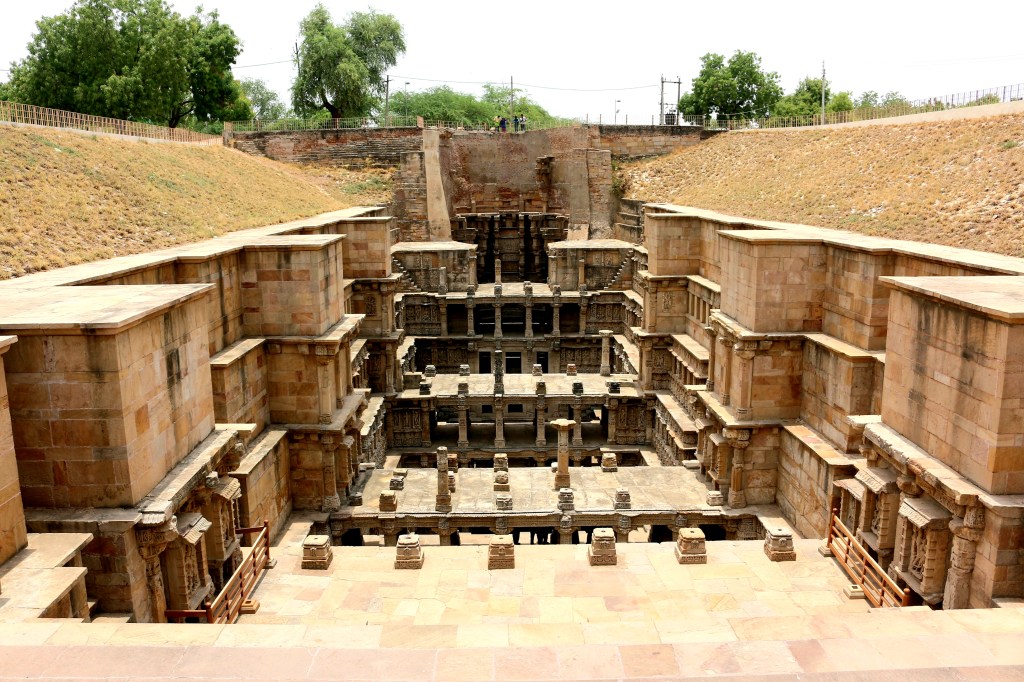
An ancient stepwell can appear, at first, like a building turned upside down. Instead of rising above the ground, its galleries, pillars and flights of steps descend towards a pool that may sit far below the surrounding landscape. The deeper a visitor walks, the more the structure reveals: carved columns, shaded landings, repeating patterns and carefully arranged spaces that seem to change with every level. For a traveller accustomed to viewing monuments from the outside, entering a stepwell offers a different kind of discovery. It is an architectural journey downwards, into the history of how people lived with water.
Across the drier regions of western India, especially Gujarat and Rajasthan, stepwells developed as practical responses to seasonal rainfall and changing water levels. They allowed people to reach groundwater through a sequence of steps, platforms and access corridors. Their design made it possible to descend as the water level changed through the year, while shaded areas offered relief from intense heat. The structures were not identical; local materials, patronage, engineering knowledge and artistic traditions shaped each one. Yet they shared a central idea: a vital resource could be made accessible through thoughtful architecture rather than treated as something that simply appeared when needed.
Rani ki Vav in Patan is among the most celebrated examples. Its richly carved levels create an extraordinary sense of depth, with sculptural panels and pillars arranged along the descending route. The stepwell is often described as an inverted temple because of the way its design guides the visitor down through increasingly intimate architectural spaces. The experience is not limited to admiring decoration. It encourages a person to notice how engineering and symbolism exist together, how a structure built around water can also express the beliefs, artistic skill and ambitions of the society that created it.
Other stepwells reveal different expressions of the same ingenuity. Some are known for dramatic geometric patterns, while others are remembered for intricate stonework, long corridors or the way sunlight reaches their lower levels. A traveller visiting more than one can begin to recognise the shared principles without assuming that every site tells the same story. Each has its own relationship with the surrounding settlement, landscape and history. The variety is part of the attraction: stepwells are not a single architectural formula but a family of places shaped by local needs and imagination.
The most rewarding visit often begins with slowing down. From the upper edge, a stepwell may look like a symmetrical arrangement of stone. As the visitor descends, the temperature can change, the sound of the outside world becomes softer and the pattern of light shifts across the walls. Details that were difficult to see from above become clearer at eye level. A carved figure, a worn step or a line of stone joints can reveal the work involved in constructing and maintaining the monument. The experience rewards attention more than speed, and a few unhurried minutes can make the scale of the structure easier to understand.
Stepwells also invite questions about the people who used them. Water collection was only one part of their role. Depending on the place and period, these spaces could serve as points of gathering, rest and social exchange. Travellers, residents and workers might meet there as part of daily routines. The shaded platforms offered a pause from the heat, while the approach to water created a shared reason to visit. A monument can therefore be understood not only through its royal patrons or architectural style but also through the ordinary lives that once moved through it.
Their construction required a sophisticated understanding of materials, loads, drainage and the behaviour of water. Stone had to be shaped and placed so that the structure could remain stable while exposed to moisture and changing groundwater levels. The arrangement of steps and landings had to support movement, access and maintenance. These practical decisions are easy to overlook when attention is drawn to ornate carvings, yet they are what allowed the decorative elements to endure. The stepwell is a reminder that engineering and beauty do not need to compete. In many historic structures, each gives meaning to the other.
Visiting such sites responsibly matters. Many stepwells are protected heritage places, and their stone surfaces can be vulnerable to careless handling, litter and unauthorised activity. Visitors should follow posted rules, remain within permitted areas and avoid climbing onto fragile carvings for photographs. Local guides can provide context that a quick online description cannot, including details about restoration, water systems and community traditions. A respectful visitor also recognises that a monument may hold religious or cultural significance for people who live nearby. Curiosity is most valuable when it is accompanied by care.
Stepwells can also change the way a traveller thinks about water in the present. In cities where water arrives through taps and pipes, it is easy to forget the planning and collective effort required to secure it. These structures make that relationship visible. Their scale suggests that water was not merely a private convenience but a matter of community organisation, public investment and long-term thinking. They prompt questions about how settlements respond to scarcity, how knowledge is passed between generations and what can be learned from systems designed around local climate rather than a single universal solution.
A visit to an ancient stepwell may last an hour, but the questions it leaves behind can travel much further. The visitor begins by noticing a staircase and ends by considering architecture, ecology, craft, social life and the value of shared resources. The monument is both practical and imaginative, both grounded in a local need and expressive of a larger cultural world. For travellers seeking more than another photograph of a famous building, stepwells offer a rare experience: the chance to understand a place by moving through the layers beneath its surface.

