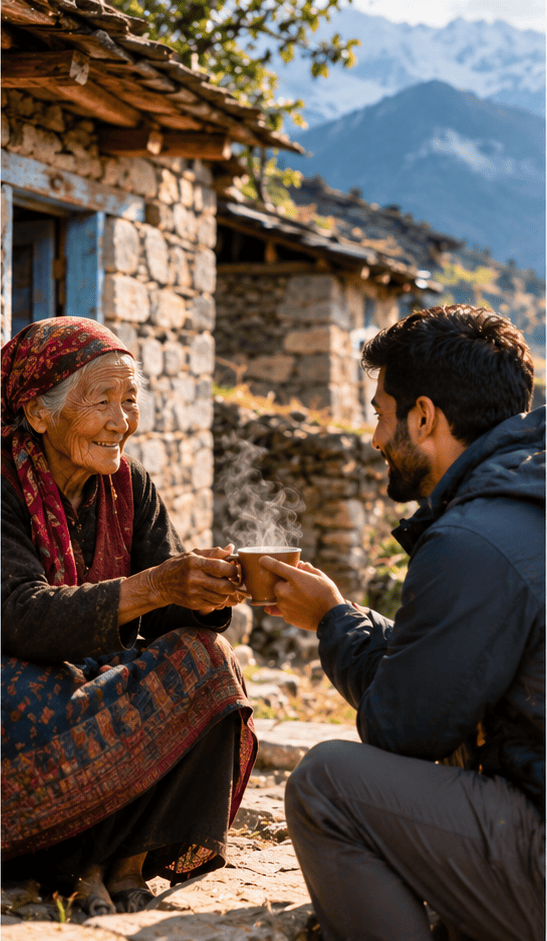
Hospitality is often remembered through details that appear too small to deserve a place in a travel diary. A cup of tea offered on a cold afternoon, a chair brought closer to a warm stove or a patient explanation given to someone struggling with directions can stay in the mind long after a hotel room or scenic viewpoint has been forgotten. These gestures do not require elaborate planning. They arise from noticing another person’s presence and making a little room for them. In unfamiliar surroundings, that simple attention can turn a brief encounter into a lasting human connection.
Every community expresses welcome in its own way. In one place, it may begin with food placed on the table before a guest has finished taking off a coat. Somewhere else, it may be a neighbour who walks alongside a visitor until the correct lane appears. A greeting, a shared meal or an offer to rest can carry meanings that are shaped by local customs. Travellers who approach these moments with curiosity rather than expectation are more likely to appreciate them. Hospitality is not a performance that every host must provide; it is a relationship shaped by context, choice and mutual respect.
Small gestures are powerful partly because they reduce the distance between strangers. A person arriving in a new town may be uncertain about the language, transport system or social habits. Even a short interaction can make the environment feel less intimidating. The person offering help may see it as an ordinary part of the day, while the visitor remembers it as the moment the place began to feel approachable. The same thing happens in workplaces, neighbourhoods and social gatherings, where a newcomer often needs only a little patience to feel included.
Food and drink frequently become the centre of these exchanges. A shared cup of tea gives people a reason to pause, even when they do not have a common language. The conversation may be limited to a few words, gestures and smiles, but the act of sitting together creates a small space of familiarity. A dish prepared at home can reveal something about local ingredients, family habits and seasonal traditions. The most meaningful part is rarely the recipe alone. It is the attention behind the invitation and the willingness to share something that belongs to everyday life.
Hospitality also depends on the person receiving it. Gratitude does not need to be dramatic, but it should be sincere. A guest who accepts help with respect, listens to an explanation and recognises the effort involved contributes to the exchange. It is equally important to understand that an invitation can be declined, that a host may be busy and that kindness should never be treated as an entitlement. Cultural sensitivity means observing boundaries rather than assuming that every custom is familiar or that every person is comfortable with the same level of interaction.
The value of hospitality becomes especially clear when plans go wrong. A delayed bus, sudden rain or an unfamiliar route can leave a traveller feeling vulnerable. Someone who offers shelter for a few minutes or explains the next connection may change the entire mood of the day. The practical assistance matters, but so does the feeling of not having to solve every difficulty alone. These experiences remind people that independence and connection are not opposites. A capable traveller can still appreciate help, just as a confident local can enjoy meeting someone from elsewhere.
Hospitality is not limited to travel. In ordinary life, it can be expressed by remembering a colleague’s name, making space for a quiet person in a conversation or checking whether a neighbour needs assistance carrying something heavy. It may involve introducing two people who could benefit from knowing each other, or giving a visitor clear directions without making them feel foolish for asking. Such actions are easy to overlook because they do not create a visible achievement. Their effect is often measured in how comfortable another person feels.
Modern routines can make these gestures less frequent. People move quickly, communicate through screens and often assume that everyone around them is managing well. A deliberate pause can therefore feel unusually generous. It does not need to become a large commitment. A few minutes of attention, a clear answer or a thoughtful welcome may be enough. The important part is that the gesture is genuine and appropriate to the situation, not offered as a way to gain praise or create an obligation.
There is also a quiet confidence in being able to welcome someone without needing to impress them. A simple home, an ordinary meal and an honest conversation can be more comforting than an elaborate arrangement. When people stop measuring hospitality by expense or appearance, they discover that its strongest ingredients are attention, generosity and respect. A place does not need to be perfect to make someone feel welcome. It needs people who are willing to see a guest as a person rather than an interruption.
Long after a journey ends, the memory of a place often becomes attached to the people who made it feel human. The landscape may have been beautiful, but a stranger’s kindness gives the memory warmth. In the same way, the people who offer small gestures may never know how far their actions travel. A cup of tea, a patient explanation or a few moments of company can become part of someone’s story. Hospitality works quietly, passing from one person to another, and reminding each of them that belonging can begin with something very small.

